Quick Links — Paris
Resources mentioned in this guide. These are affiliate links — I earn a small commission at no extra cost to you.
In This Guide
Let me be honest about something: Paris has a reputation for being brutally expensive, and that reputation is about 40% deserved. Yes, a café terrace on Boulevard Saint-Germain will charge you €7 for a coffee and not feel remotely bad about it. Yes, a tourist restaurant within 200 metres of the Eiffel Tower will deliver mediocre steak-frites at the price of a decent meal in London. But the other 60% of that expensive reputation is myth — the result of bad planning, no local knowledge, and a tendency to default to wherever the guidebook says.
I've now been through Paris probably a dozen times. Some trips were properly funded work trips; most were me threading the city on a consultant's off-day budget — a few hundred euros, a train connection to make, and no appetite for getting ripped off. This guide is what I've actually learned. Not theory. Actual tactics.
Free Things to Do in Paris
The single most important thing to know about Paris: it has more world-class free attractions than almost any other capital on earth. The problem is that most visitors don't know which ones are free, or when.
The Louvre — First Sunday of the Month
The Louvre is free on the first Sunday of every month, from October through March. That's not a rumour or a loophole — it's official policy. The trade-off is crowds, so arrive right when it opens at 9am. Book your free timed-entry ticket online in advance (still required even for free entry). In high season you may queue for 30–40 minutes regardless; in November or February you can often walk straight in. Do not skip this if your visit happens to land on that date.
If you're visiting outside that window, consider whether you actually need the Louvre. It's enormous, it takes half a day to see even a fraction of it, and the €22 ticket is fair value if you use it properly. But if your goal is art rather than the specific Louvre brand, the Musée d'Orsay across the river has the Impressionist collection that many people actually find more interesting — and it's free under 26 for EU residents.
Musée d'Orsay — Free for Under 26s and on Select Dates
Entry to the Musée d'Orsay is free for anyone under 26 who's an EU citizen or resident. If you're 26 (as I am), you're just over the line — but the museum also runs free late nights on Thursdays until 9:45pm for first-Friday-of-the-month events, and is free on the first Sunday of the month (same as the Louvre). Van Gogh, Monet, Degas — this is the collection. Worth the full €16 ticket if none of the free windows line up with your visit.
Père Lachaise Cemetery
Père Lachaise is free, permanently, and it's one of the strangest and most affecting places in Paris. Jim Morrison's grave draws the predictable pilgrimages, but the more interesting wander is through the older sections — 19th-century mausoleums gone to moss and ivy, Chopin, Proust, Colette, Edith Piaf. Budget two hours. It's enormous (44 hectares) and genuinely beautiful in an overgrown, baroque way. Take the free map at the entrance.
Palais Royal Gardens
The arcades and gardens of the Palais Royal sit right behind the Louvre and almost nobody wanders in. It's free to walk through, genuinely peaceful compared to the surrounding tourist crush, and the Daniel Buren striped columns in the courtyard make a better photo than most of the stuff visitors pay to see. Grab a coffee from one of the café terraces under the arcade and sit in the garden.
The Sainte-Chapelle Trick
Sainte-Chapelle is one of the most beautiful Gothic buildings in the world — floor-to-ceiling stained glass in a chapel so delicate it looks like it's made entirely of light. Entry is €13. Here's the thing though: the chapel sits inside the Palais de la Cité complex on Île de la Cité. If you have a Paris Museum Pass (see the money-saving section), Sainte-Chapelle is included. If you're visiting without a pass, combine your Sainte-Chapelle ticket with the adjacent Conciergerie — they share a joint ticket for €18.50, which is better value than either alone.
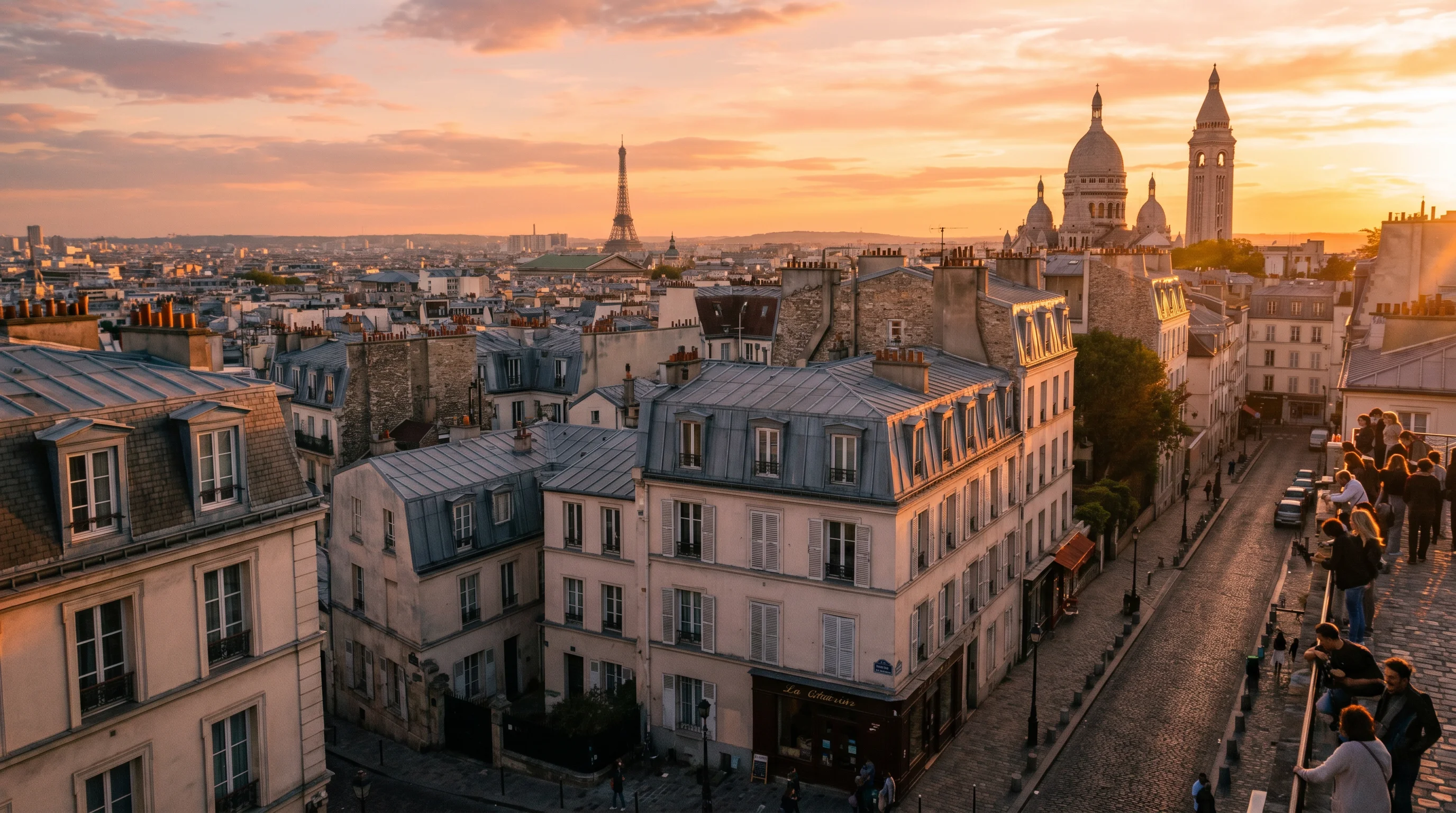
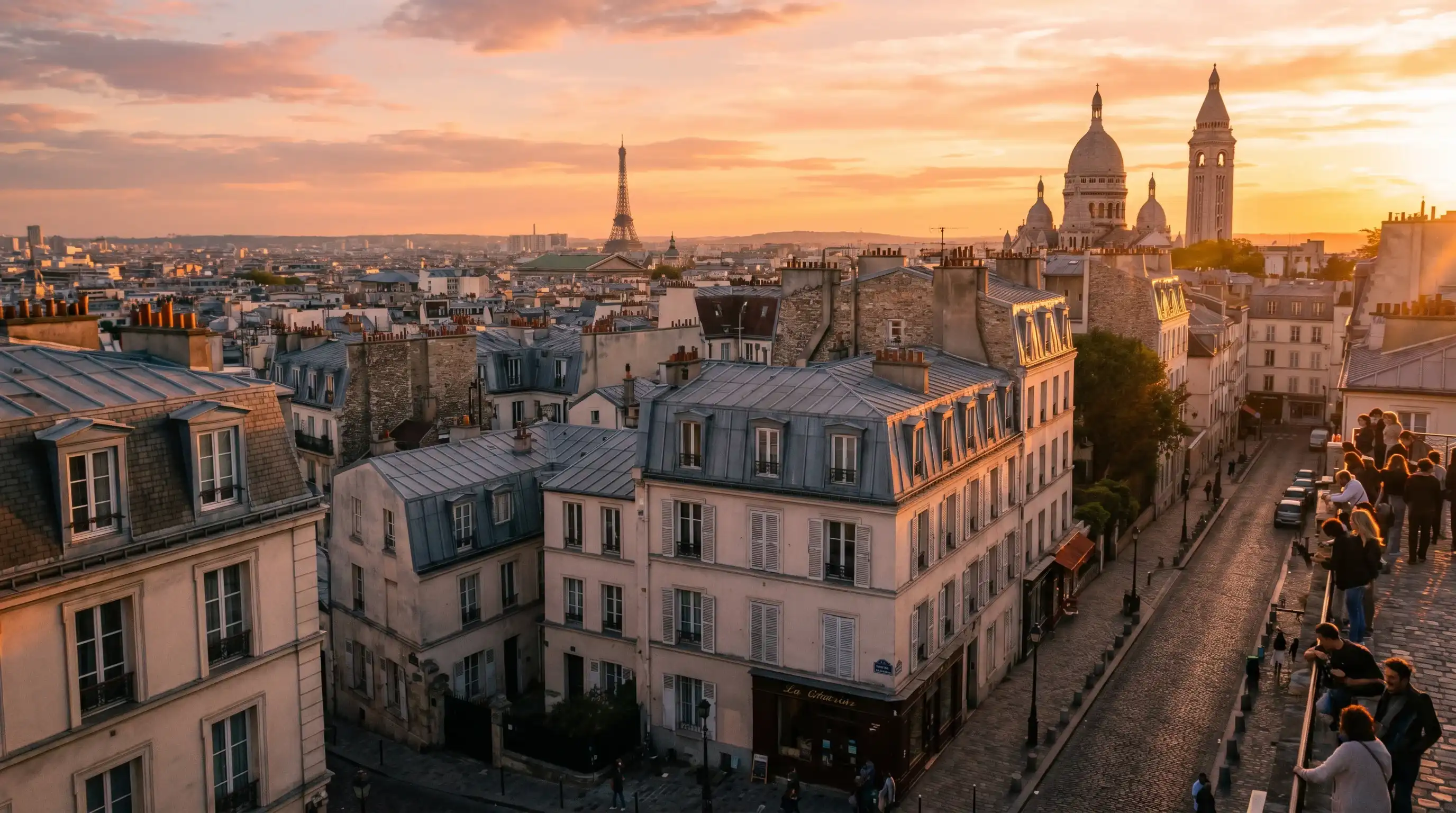
Other things that cost nothing: walking the Canal Saint-Martin, watching the city from the Sacré-Cœur steps at sunset, any of the city's 400+ parks, the exterior of Notre-Dame (reconstruction ongoing as of 2026, reopened December 2024 — the interior now has ticketed timed entry), the Institut du Monde Arabe roof terrace, and every single street market in the city.
Find a Budget Hotel in Paris
The right arrondissement matters more than the star rating. I use Booking.com for the free-cancellation filter — essential when plans change. Search by neighbourhood, not just price.
Eating Well Cheaply in Paris
The food situation in Paris is simultaneously better and worse than most tourists expect. Worse because the tourist-trap density is genuinely high — any restaurant that has its menu in five languages and a photo of the Eiffel Tower in the window should be avoided at all costs. Better because the parallel ecosystem of good, cheap, local food is vast and mostly just requires walking two streets off the main drag.
Boulangeries: Your Primary Meal Strategy
A baguette costs €1.20 by law (there's a regulated price). A croissant is €1–1.50. A jambon-beurre sandwich (ham and butter on a baguette) is €3–5 at any boulangerie that's not in a train station. This is breakfast and lunch sorted for under €10 combined, and it will frequently be better than what people paid €18 for at a tourist café nearby. Paris takes its boulangeries seriously — there's an annual competition for best baguette in the city, and the winner gets to supply the Élysée Palace. Any boulangerie with a queue of locals is worth the wait.
The Marchés: Rue Mouffetard and Beyond
Rue Mouffetard in the 5th arrondissement is a market street that runs downhill from Place de la Contrescarpe — cheese vendors, fishmongers, rotisserie chicken, seasonal produce, and street food. Go on a Saturday morning when it's fully operating. Pick up cheese, fruit, and bread and eat in the nearby Jardin des Plantes. Marché d'Aligre in the 12th (open mornings except Monday) is less touristed and even better for produce. The covered Marché des Enfants Rouges in the Marais (open Tuesday–Sunday) has prepared food stalls — Japanese, Moroccan, Lebanese — at market prices.
Avoiding Tourist Traps
The tourist-trap geography of Paris is fairly predictable. Anywhere immediately surrounding a major attraction — the Eiffel Tower, the Louvre, Montmartre's place du Tertre — is marked up significantly. The rule I use: if there's a hostess standing outside trying to hand you a laminated menu, walk away. If the menu has photos of the food, walk away. If they have a special "tourist set menu" advertised in English in the window, definitely walk away.
Look instead for the formule — a fixed-price lunch menu usually at €12–18 that includes an entrée, plat, and sometimes dessert or wine. Almost every proper French restaurant offers this at lunch. It's how locals eat affordably at places that would otherwise cost twice as much for dinner. The quality is identical.
The Carrefour City Strategy
Urban supermarkets (Carrefour City, Monoprix, Franprix) have prepared food sections — salads, hot dishes, sandwiches, sushi — at grocery prices. A complete meal can be under €6. This isn't settling; French supermarket prepared food is genuinely decent. For breakfast especially, this beats any hotel buffet at a fraction of the cost.
"A jambon-beurre from a proper boulangerie will frequently be better than what people paid €18 for at a tourist café two streets away."
Getting Around Paris
Transport is one area where Paris is genuinely, structurally cheap — if you use it correctly. The Metro system is extensive and reliable, and the pricing is flat-rate per zone, which means any journey within central Paris costs the same regardless of distance.
The Navigo Pass: Buy This First
If you're staying more than three or four days, the weekly Navigo Découverte pass (Zones 1–5, covering all of central Paris plus Versailles, CDG Airport, and Orly) costs €30 and gives you unlimited travel for the week. The pass itself costs €5 to purchase and requires a passport photo — bring one, or use the photo booths at major Metro stations. For comparison, individual Metro tickets are €2.15 each; five Metro journeys a day over five days is €53.75 versus €30 with the weekly Navigo. The maths is straightforward.
Important: the Navigo week runs Monday–Sunday, not from the day you buy it. If you arrive on a Thursday, you only get 4 days from a weekly pass. In that case, a carnet (book of 10 tickets) at €17.35 is better value for short stays. The Navigo can be loaded onto the Navigo Découverte card or via the Île-de-France Mobilités app on your phone.
CDG Airport Transfer Options
Charles de Gaulle is 25km northeast of central Paris, and the transfer options range wildly in cost:
- RER B train (€11.80 one-way): Runs directly from CDG Terminal 2 and Terminal 1 (with a free CDGVAL shuttle) to central Paris stations including Châtelet-Les Halles, Saint-Michel, and Denfert-Rochereau. Journey time is 35–45 minutes. This is the correct option for almost everyone. It works with the Navigo pass if your pass is already loaded.
- Roissybus (€16.60): A dedicated bus running to Opéra. Slower than the RER (45–75 minutes depending on traffic) but useful if you're staying near Opéra or Grands Boulevards. Smoother ride with luggage.
- Taxi (€52–65 fixed rate): Fixed-rate taxis from CDG exist — €52 to Left Bank, €65 to Right Bank. Legitimate if you have a lot of luggage or are arriving very late. Never take unlicensed taxis from the arrivals hall; always use the official taxi rank.
- Uber/Bolt (€35–55): Typically cheaper than a taxi but surge pricing applies at peak times. Meet your driver in the designated rideshare pick-up zone (not arrivals).
My default: RER B every time. It's the fastest to any central arrondissement, runs frequently, and costs less than a mediocre lunch.
Where to Sleep in Paris
Accommodation is where Paris can genuinely hurt a budget, but arrondissement selection makes an enormous difference to both price and experience.
The Arrondissement Strategy
Paris has 20 arrondissements, numbered in a clockwise spiral from the centre. The tourist pressure (and pricing) concentrates heavily in the 1st, 4th (Marais), 5th (Latin Quarter), 6th (Saint-Germain), and 7th (Eiffel Tower). These aren't bad — but you'll pay 30–50% more for the same quality accommodation compared to one Metro stop further out.
The best budget-smart arrondissements right now:
- 11th (Oberkampf/Bastille): My personal pick. Excellent restaurant scene, genuine local neighbourhood feel, and well-connected by Metro lines 1, 5, 8, and 9. It's where Parisians in their 20s and 30s actually live. Prices for a decent 2-star or budget hotel are often 25–35% lower than the Marais, which is one Metro stop away.
- 18th (Montmartre area, lower slopes): Beautiful neighbourhood but avoid the tourist drag immediately around Sacré-Cœur. The lower slopes of Montmartre around Abbesses and Lamarck–Caulaincourt have genuinely good accommodation at lower prices. Warning: the upper reaches around Pigalle can feel rough late at night.
- 20th (Belleville/Ménilmontant): The most genuinely Parisian arrondissement in terms of a mixed, multicultural neighbourhood. Excellent for budget eats, interesting street art, and a real sense of the city. Less central, but the Metro (lines 2, 3, and 3bis) gets you into the centre in 15 minutes.
- 13th (Butte-aux-Cailles): South of the centre, well-connected, and notably cheaper. Less touristed, has a good food scene in the Butte-aux-Cailles village area.
Hostels remain a legitimate option even as a 26-year-old consultant — I've stayed in private rooms at places like Generator Paris (11th) and St Christopher's Inn at Gare du Nord for €40–55 per night during off-peak periods. These aren't sacrifice stays; the facilities are genuinely good. For a budget hotel, anything with an "okay" rating and 200+ reviews on Booking.com is usually reliable at the €70–100/night mark in the outer arrondissements.
Getting to Paris Cheaply
Kiwi.com is my go-to for finding routing combinations that airlines don't advertise directly — particularly useful for Stuttgart connections. Set up price alerts 6–8 weeks out.
Book accommodation in the 11th or 12th arrondissement instead of the tourist-heavy 1st–4th. You'll pay 30–40% less, be surrounded by actual Parisians, and have great metro access to everything. Oberkampf and Nation are both excellent bases.
Day Trips from Paris (That Won't Destroy the Budget)
The Versailles Hack
Versailles gets a reputation as expensive because the main palace ticket is €21. Here's the thing: the gardens of Versailles are free to enter outside of the Grandes Eaux Musicales fountain shows (which run weekends from April to October and cost €10.50 extra). On a weekday, you can walk the entire grounds — the Grand Canal, the Petit Trianon gardens, the Grand Trianon's exterior, the bosquets — without paying anything. The grounds alone are 800 hectares. This is genuinely an all-day visit at no cost.
If you want the palace interior (the Hall of Mirrors, the royal apartments), the €21 ticket is fair — it's an extraordinary building. But you can have an outstanding day at Versailles without going inside the palace at all, and the gardens are arguably the more impressive achievement anyway.
Getting there: take the RER C from central Paris to Versailles-Château-Rive Gauche (included in the weekly Navigo Zones 1–5 pass). Journey time is about 35–40 minutes.
Fontainebleau: The Better Versailles
An hour south of Paris by Transilien N train (included in your Navigo pass if you have Zones 1–5), Fontainebleau is the royal château that Versailles tried to emulate and couldn't quite match for setting. The town is charming, the surrounding forest is 25,000 hectares of sandstone boulders and old oaks (famous among climbers), and the château courtyard is free to walk around. Interior tickets are €14, considerably less than Versailles, with much smaller crowds.
Fontainebleau gets far fewer tourists than Versailles precisely because it requires a longer train journey. That's exactly why it's worth the trip.
The Money-Saving Framework: Museum Pass and Flight Booking
Paris Museum Pass — Worth It or Not?
The Paris Museum Pass covers 50+ museums and monuments including the Louvre, Musée d'Orsay, Musée de l'Armée (with Napoleon's tomb), Sainte-Chapelle, the Conciergerie, Versailles palace interior, and Fontainebleau palace. Pricing: €55 for 2 days, €70 for 4 days, €85 for 6 days.
Whether it's worth it depends entirely on your visit pattern. Do the maths before you buy:
- Louvre: €22
- Musée d'Orsay: €16
- Sainte-Chapelle: €13
- Versailles (palace): €21
Just those four gets you to €72, which already beats the 4-day pass at €70. If you're planning to hit major museums every day, the pass is mathematically correct. If you're combining free attractions with one or two paid ones, skip it.
One underrated benefit beyond price: the Museum Pass lets you skip the ticket queue at most attractions. In July and August, the Louvre ticket queue alone can be 45 minutes. That time savings has real value.
When to Book Flights
From Stuttgart, Paris is honestly better served by train than flight for most people — the Stuttgart–Paris TGV runs via Strasbourg or Basel and takes about 3.5 hours city-centre to city-centre, which beats flying once you factor in airport time. For anyone coming from further away, the general flight-booking rule that holds up in my experience: book 6–8 weeks out for European routes, 8–12 weeks for transatlantic. Tuesday and Wednesday departures are measurably cheaper than Friday–Sunday. Early morning and late evening flights are cheaper than midday, and CDG is generally better-served (and cheaper to reach) than Orly or Beauvais.
Set alerts on Kiwi.com or Google Flights rather than refreshing manually. Paris is a major hub so prices fluctuate frequently — alerts catch the dips.
Ready to Book?
Lock in your accommodation before prices move. Free cancellation gives you flexibility if plans change.
The Short Version
Paris doesn't have to be expensive. The free tier is genuinely extraordinary — Père Lachaise, the Palais Royal, the Canal Saint-Martin, the city's parks, the Louvre on the first Sunday, the boulangeries on every corner. The expensive tier exists if you want it (and some of it — a long dinner at a proper bistro, a museum pass, the Versailles palace — is worth every euro). The art is in choosing deliberately rather than defaulting to whatever's in front of you.
My actual budget for a 4-day Paris visit staying in the 11th, using the Navigo weekly pass, eating boulangerie lunches and one proper dinner each night, and doing the Museum Pass for three major museums: approximately €350 all-in, excluding flights. That's Paris done properly. Not skimped on — properly.