Quick Links — Krakow
Everything you need to plan the trip in one place.
In This Guide
Krakow is one of the only major Central European cities that wasn’t systematically flattened in World War II. Warsaw was. Dresden was. Krakow, by some combination of strategic irrelevance and last-minute German retreat, survived more or less intact. That’s why, when you walk into Rynek Główny — the main medieval market square — it doesn’t feel like a reconstruction. The stone is old, the buildings are genuinely old, and the St. Mary’s Basilica trumpet call that rings out every hour has been ringing out since the 13th century.
It also happens to be one of the most affordable cities in Europe for the quality of what you get. Milk bar lunch for under 15 PLN (€3.50). A half-liter of Żywiec at a Kazimierz bar for around 10–11 PLN (€2.50). Wawel Castle’s State Rooms for 49 PLN (€11.50). Even the Wieliczka Salt Mine — the big day-trip attraction — runs about 120–150 PLN (€28–35) per person in 2026, which is cheap for what it delivers (300 meters underground, cathedrals carved entirely out of salt, statues of kings made of salt — you get the picture).
The city has a student population that makes up over a quarter of all residents, which keeps the prices honest and the nightlife genuinely lively. Here’s what to know before you go.
Getting There
By Train (Example: Central Europe)
Krakow is more of a connecting-city rail trip than a one-seat arrival from western Europe. Using southern Germany as an example, you’ll usually route through Vienna, Prague, or Warsaw depending on schedule and pricing. The fastest options tend to land in the 12–14 hour range with two changes, and advance fares can start around €45–49.
One of the more logical itineraries for a longer Central Europe trip is southern Germany → Vienna → Krakow. That breaks the journey cleanly, keeps you on major rail corridors, and fits naturally with the kind of multi-city routing covered in the Central Europe trains guide.
If you want to come in via Prague instead, Prague → Krakow works well as a standalone leg for a multi-city trip and typically takes around 7–9 hours by direct train or bus. It’s a more flexible route if you’re already moving through the Czech Republic.
Budget airlines also connect parts of Germany with Krakow. Compare flight and train prices — for long distances, cheap flights can beat a 12–14 hour rail day. The airport is 15 km west of the city, and the train into Krakow Główny runs in about 17–18 minutes (5 PLN, or ~€1.20, as of 2026).
Krakow's Old Town and Kazimierz operate a Clean Transport Zone (Strefa Czystego Transportu) that restricts private vehicle access. The zone has been in force since 2024 and covers most of the historic center. Unless you're staying somewhere with private parking outside the zone, getting there by train or plane and using public transit entirely within the city is the obvious move.
Getting Around
Krakow’s historic core — Old Town, Wawel, Kazimierz — is walkable in its entirety. The distance from the Main Market Square down to the heart of Kazimierz is about 1.5 km, a 20-minute walk through genuinely interesting streets. You don’t need transit for any of the main sights.
Trams and buses cover everything else, and the pricing updated in March 2026. Current fares from the official ZTP Krakow ticket guide:
- 30-minute single ticket: 6 PLN (~€1.40)
- 60-minute ticket: 8 PLN (~€1.90)
- 24-hour pass: 17 PLN (~€4)
- 72-hour pass: 55 PLN (~€13)
For a 3–4 day trip, the 72-hour pass is straightforward. Buy it at any tram stop ticket machine or via the jakdojade app (widely used and reliable). For the airport train specifically, buy your ticket at the Krakow Główny station platform before boarding — 5 PLN (~€1.20).
Old Town and Wawel
Rynek Główny
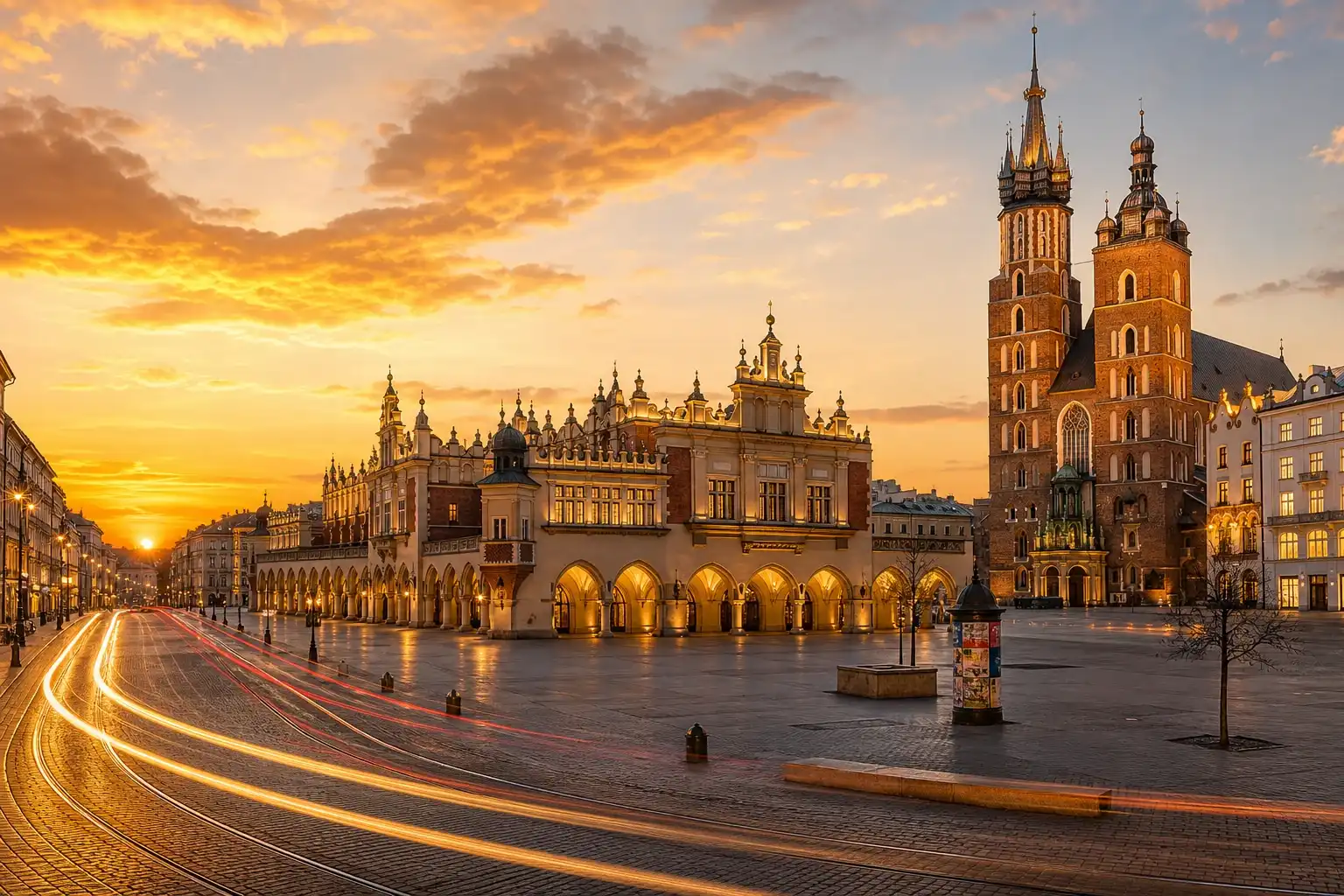
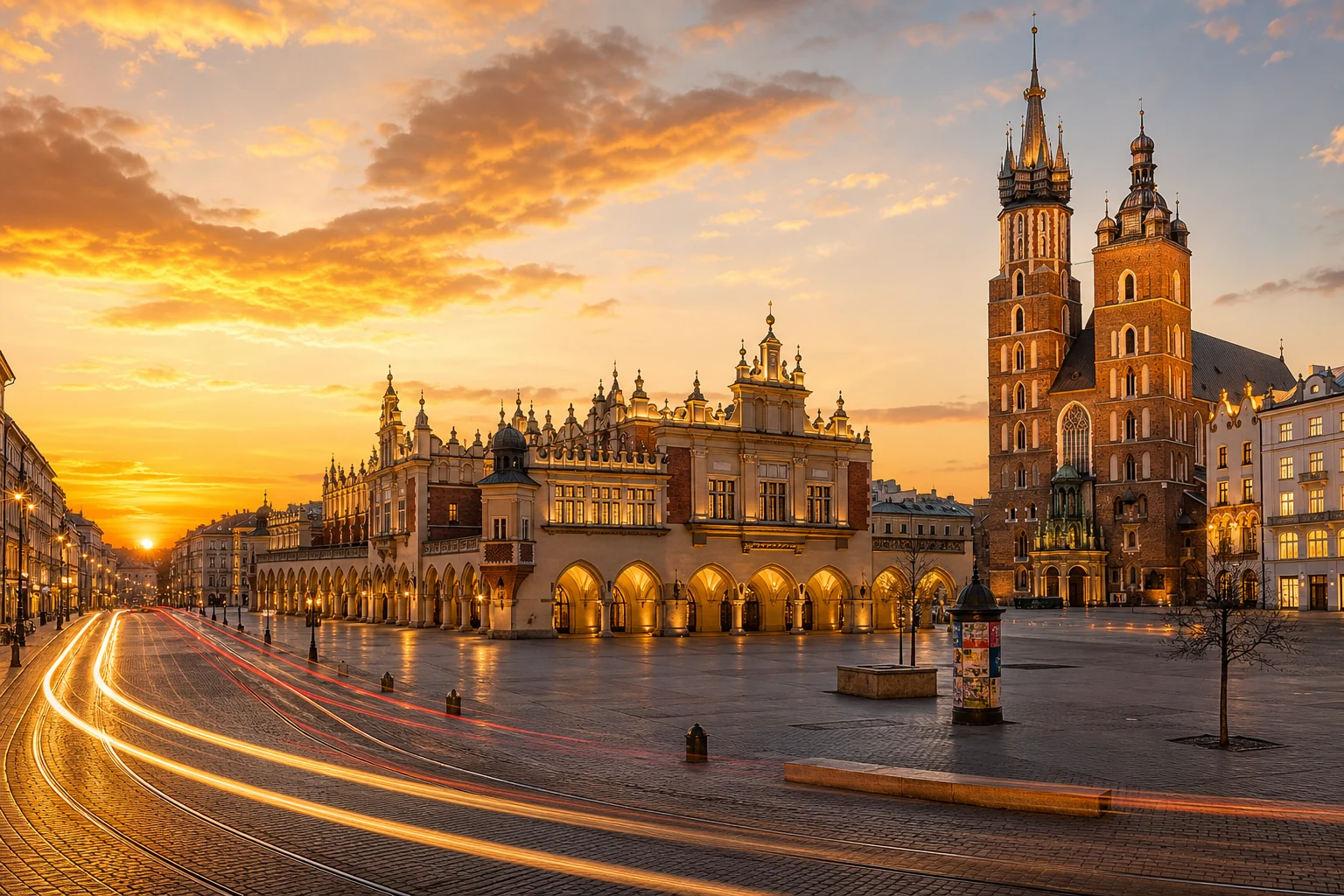
The Main Market Square is one of the largest medieval market squares in Europe — 200 meters per side, ringed by Gothic and Renaissance townhouses, with the Cloth Hall (Sukiennice) running through the middle and St. Mary’s Basilica anchoring the northeast corner. It’s undeniably impressive, and it’s also undeniably full of tourists by 10am. The move is to be there at 7 or 8am when the square belongs to dog walkers and delivery vans, have a coffee at one of the outdoor terraces when they open, and then let the tour buses arrive without you.
The Cloth Hall (Sukiennice) has a free upstairs gallery of 19th-century Polish painting that most people walk past — worth 30 minutes if you’re interested in how artists were processing national identity during a period when Poland didn’t exist as a country.
St. Mary’s Basilica: admission is 15 PLN (~€3.50). The interior — the medieval altarpiece by Veit Stoss, the blue-starred vaulted ceiling, the Gothic choir stalls — is exceptional. Worth seeing in the morning when the light comes through the stained glass on the right side.
Wawel Castle
The castle complex sits on a limestone outcrop above the Vistula River, about a 15-minute walk south of the Main Square down the Royal Road. It’s the site of Polish coronations, the royal treasury, and several centuries of architectural layering. The courtyards are free to enter. The paid exhibitions are ticketed separately:
- Royal State Rooms (the main draw): 49 PLN regular (
€11.50), 30 PLN reduced (€7) - Crown Treasury and Armoury (includes the royal regalia and the Szczerbiec coronation sword): 35 PLN regular (
€8.50), 25 PLN reduced (€6) - Dragon’s Den (a natural cave under the castle with a fire-breathing dragon sculpture at the exit — legitimately fun): 12 PLN at the machine on-site (~€3)
- Wawel for Enthusiasts bundle (all exhibitions): 199 PLN regular (~€47)
Online booking is advisable in summer — the State Rooms in particular have timed-entry capacity limits. On Mondays in summer, the Crown Treasury and Armoury is free, but the queues are predictably long.
Kazimierz
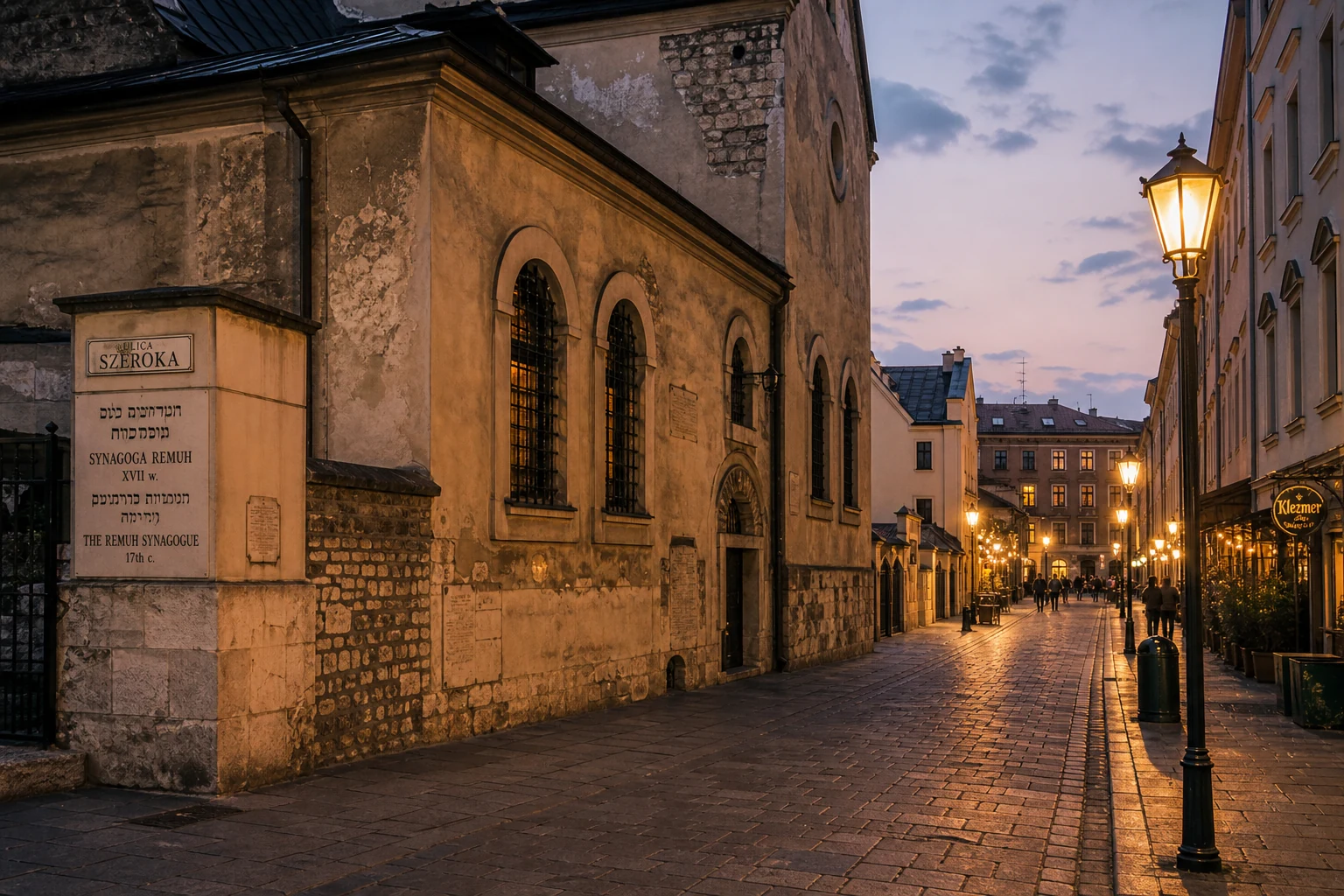
Kazimierz is the former Jewish quarter, about 20 minutes on foot south of the Main Square. It’s one of the most significant Jewish heritage sites in Europe — not because it was preserved as a museum, but because it was largely abandoned after the Holocaust and survived through neglect until the 1990s. The result is a neighborhood that feels genuinely layered: pre-war synagogues next to microbreweries, the Old Jewish Cemetery next to a square full of food stalls, antique shops next to design studios.
The Old Synagogue on Szeroka Street is the oldest in Poland and now a museum of Jewish history in Krakow (15 PLN entry, or ~€3.50). The Galicia Jewish Museum on Dajwór Street runs powerful photographic exhibitions documenting both the historical Jewish community and contemporary Polish-Jewish cultural dialogue.
Plac Nowy is the central square in Kazimierz, ringed by bars and the city’s most famous street food: zapiekanka — an open-faced baguette with melted cheese, mushrooms, ketchup, and various toppings, sold from the circular rotunda building in the square. Every Polish person I’ve asked describes it as hangover food or drunk food, which tells you when Kazimierz is really operating. One zapiekanka runs 20–35 PLN (~€5–8). It’s better than it sounds.
"Kazimierz has a nightlife scene that starts late and ends when the birds start, which is not something the Old Town can say. The difference between eating at 7pm and arriving at midnight is basically a different city."
At night, Kazimierz is where Krakow actually lives. The bar density on Szeroka Street and around Plac Nowy is high, prices are low, and the mix of students, locals, and travelers is genuinely international without being a tourist operation. Singer on Estery Street has been running since the 1990s and still does the best atmosphere — old sewing machine tables, dim lighting, jazz. Alchemia on Estery is a close second, more crowded but equally atmospheric.
Explore Kazimierz with a Local Guide
The Jewish heritage of Kazimierz is historically dense enough that a walking tour adds significant context — especially for the synagogues and cemetery. Several operators run 2–3 hour guided tours in English for around €20–25 per person.
Day Trips
Wieliczka Salt Mine
The salt mine is 13 km southeast of Krakow, reachable by train from Krakow Główny in about 17–20 minutes (5–6 PLN, or ~€1.20–1.40). It has been operating since the 13th century and is a UNESCO World Heritage Site. The standard tourist route takes about 2–2.5 hours and descends to 135 meters underground through carved chambers, chapels (including the stunning Chapel of St. Kinga, a full cathedral carved entirely out of halite), and lakes.
For an English-language guided tour in 2026, budget approximately 120–150 PLN per person (~€28–35). Book online in advance at the official wieliczka-saltmine.com — in summer, particularly July and August, the mine books out multiple days ahead. The mine itself is reliably cool at around 14°C year-round, so bring a layer regardless of what it’s doing outside.
Auschwitz-Birkenau
Auschwitz-Birkenau is 60 km west of Krakow, about 90 minutes by bus or organized tour. Admission to the memorial and museum is free (book a timed entry slot online well in advance — they go fast in summer, and the booking window is now 1–2 months for peak season). Guided tours are compulsory for entry during peak hours (10am–3pm); these cost around 85–100 PLN (~€20–24) and can be booked via the official Auschwitz museum website or through GetYourGuide.
I don’t know how to tell anyone to approach Auschwitz except to say: give it a full day, not half a day. Most people underestimate how long they’ll want to stay.
Where to Eat
Milk Bars (Bar Mleczny)
The milk bar — bar mleczny — is a Polish institution that predates the communist era but became widespread under it as a state-subsidized canteen. They survived because the food is good and the prices are genuinely low. You order at a counter, point at what you want if your Polish isn’t up to reading the menu, and eat at a communal table for around 15–30 PLN (~€3.50–7) for a full meal.
Bar Mleczny Pod Temidą on Grodzka Street is the most central and serves excellent pierogi, barszcz (beet soup), and żurek (sour rye soup with egg and sausage). Milkbar Tomasza on Tomasza Street is a slightly more modern take — cleaner, better lit, same principle, popular with students. Both serve lunch. Neither serves dinner — milk bars keep early hours.
Polish Food Beyond the Milk Bar
For sit-down Polish food with more atmosphere, Pod Wawelem in Planty Park near the castle has been a fixture for years — pierogi, duck, pork belly, good draft beer, decent prices (main courses around 40–70 PLN, or ~€9–16). It’s popular enough that a reservation is sensible for dinner.
Starka on Józefa Street in Kazimierz is one of the better modern Polish restaurants — the menu draws on traditional recipes but executes them with more care than the tourist-facing places around the market square. Slightly more expensive (main courses 50–80 PLN, or ~€12–19), but the quality justifies it.
For street food outside Kazimierz: obwarzanek — the Krakow bagel, a braided ring of chewy dough sold by vendors with small carts across the city — is 3–5 PLN (~€0.70–1.20) and genuinely good. The vendors are everywhere and easy to spot. Buy one on your way to the castle.
Book Hotels Near Kazimierz
Staying in Kazimierz puts you 10 minutes on foot from Old Town and in the middle of Krakow's best food and bar scene. Hotels here run 20–30% cheaper than equivalent options in the Old Town.
Where to Stay
Old Town (Stare Miasto) is the most obvious base for a short trip — walkable to everything, excellent architecture, good transport links. It’s also the most expensive neighbourhood and gets noisy on weekend nights. Budget €65–110/night for a decent hotel; the high end of the Old Town spectrum can reach €200+.
Kazimierz is my preference for anything longer than two nights. It’s a 20-minute walk to the Main Square, but the neighbourhood itself is where you want to spend your evenings anyway. Hotels run €45–80/night for comparable quality to Old Town. Several well-regarded boutique hotels operate out of converted pre-war buildings with a lot more character than the generic Old Town options.
Podgórze — across the Vistula River from Kazimierz — is a quieter, more residential alternative. It’s where Schindler’s Factory (now Oskar Schindler’s Enamel Factory Museum, 35 PLN entry, or ~€8.50) is located, and it’s a legitimate 5–10 minute walk from Kazimierz via the Bernatka Footbridge. Cheaper still, and increasingly popular with longer-stay visitors.
What It Costs
Krakow remains one of the most affordable major cities in Europe. Real 2026 numbers:
Budget traveler (€35–55/day): Hostel dorm from €14–18, milk bar meals for lunch (€3.50–7), casual restaurant for dinner (€8–12), 72-hour transit pass spread over the trip, one paid attraction per day.
Mid-range (€75–110/day): Hotel in Kazimierz from €50–70, lunch at a sit-down restaurant, one major day trip (Wieliczka or Auschwitz), Wawel Castle ticket, evening out in Kazimierz.
Specific verified 2026 prices:
- Beer at a Kazimierz bar: 12–18 PLN (~€3–4.25)
- Milk bar full meal: 15–30 PLN (~€3.50–7)
- Sit-down dinner, mid-range: 40–80 PLN/person (~€9–19)
- Wawel Castle State Rooms: 49 PLN (~€11.50)
- Wieliczka Salt Mine (English tour):
120–150 PLN (€28–35) - Auschwitz museum: free (timed entry); guided tour
85–100 PLN (€20–24) - 72-hour transit pass: 55 PLN (~€13)
- Zapiekanka at Plac Nowy: 20–35 PLN (~€5–8)
- Obwarzanek bagel: 3–5 PLN (~€0.70–1.20)
Currency is Polish zloty (PLN). Budget roughly €1 = 4.20–4.25 PLN at fair-market rates in 2026. Withdraw from PKO BP or Santander Bank Polska ATMs for the best rates; Euronet machines are widespread and reliably poor on conversion.
Practical Info
When to visit: May and June are excellent — mild weather, long days, the city’s outdoor café season in full swing. September and October are equally good and slightly less crowded. July and August are busy; Auschwitz booking windows stretch to 2 months ahead in peak summer.
Language: Polish. It’s not easy to pick up on a short visit. That said, English is widely spoken in tourist-facing businesses, and most younger Poles in the city speak it fluently. “Dziękuję” (JEHN-koo-yeh — thank you) and “proszę” (PRO-sheh — please/here you go/you’re welcome, depending on context) are the two words that will cover most situations.
Visa: Poland is in the EU and Schengen Zone. EU/EEA passport holders need nothing. US and most Western visitors enter visa-free for up to 90 days.
Tipping: 10% at sit-down restaurants where you liked the service. At bars, rounding up the bill is common but not obligatory. Milk bar counters: no tipping expected.
Safety: Krakow is safe. The main practical issue tourists encounter is the same as in Budapest: unlicensed taxis hailing near the market square. Use Bolt (app) or Free Now. The official taxi stands have licensed cabs, but app-based booking is cheaper and more predictable.