Quick Take
What you should know before you book
For a first Christmas-market trip, I would spend four nights in Vienna and three in Salzburg. Choose Nuremberg and Dresden for the strongest craft traditions, or Strasbourg and Nuremberg for Alsatian streets and a sharper food contrast. Travel before December 23 for the widest choice, and keep the trip to one or two bases.
- Best first trip: four nights in Vienna and three in Salzburg for market variety, museums, music, and a smaller Alpine finale.
- Best for crafts: three nights in Nuremberg and three in Dresden, with confirmed 2026 dates in both cities.
- Best for streets and food: four nights in Strasbourg and three in Nuremberg; verify Strasbourg's year-specific dates before booking.
- Best one-base plan: six nights in Vienna, especially for travelers avoiding hotel moves or arriving after December 23.
In This Guide
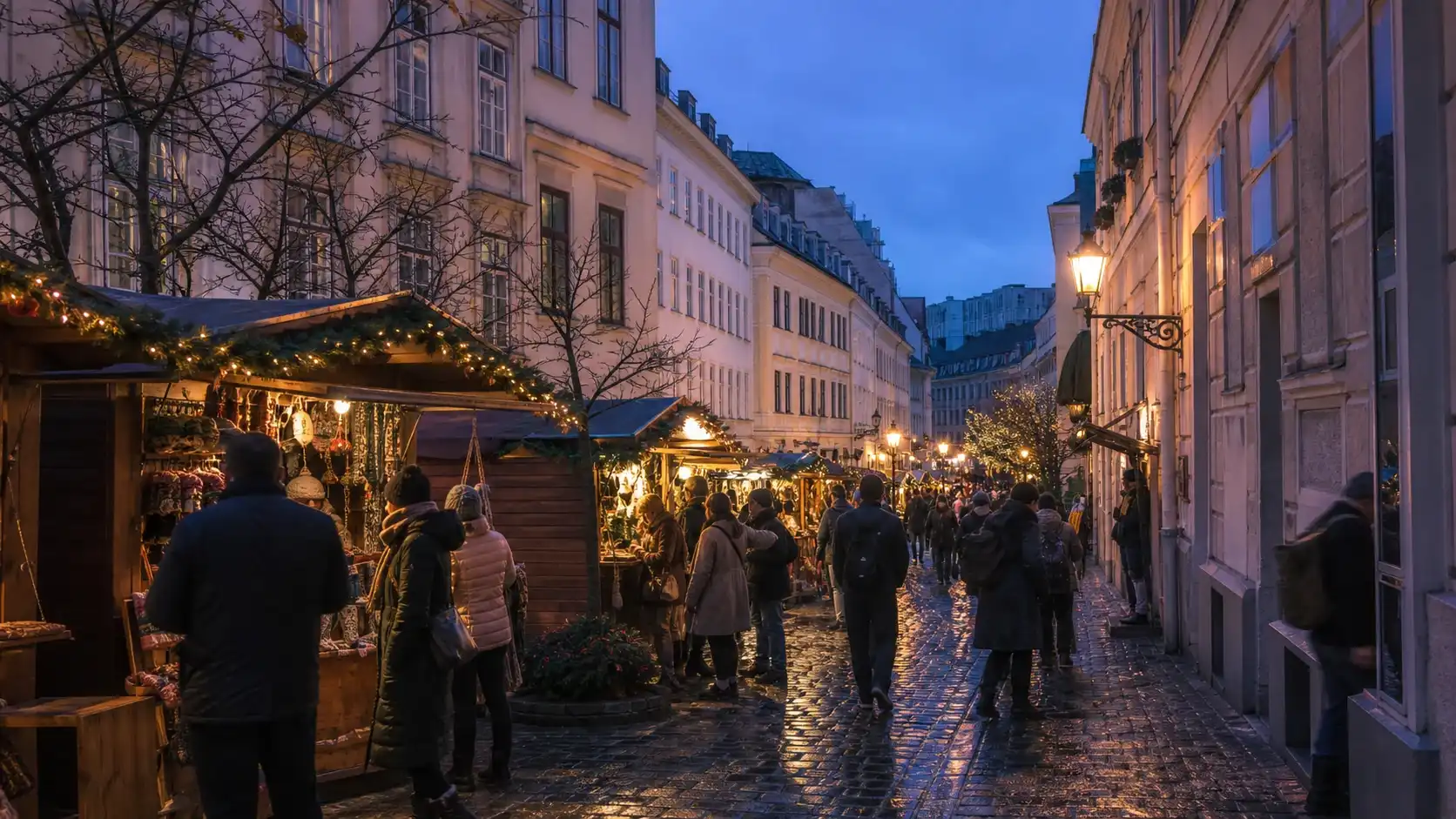
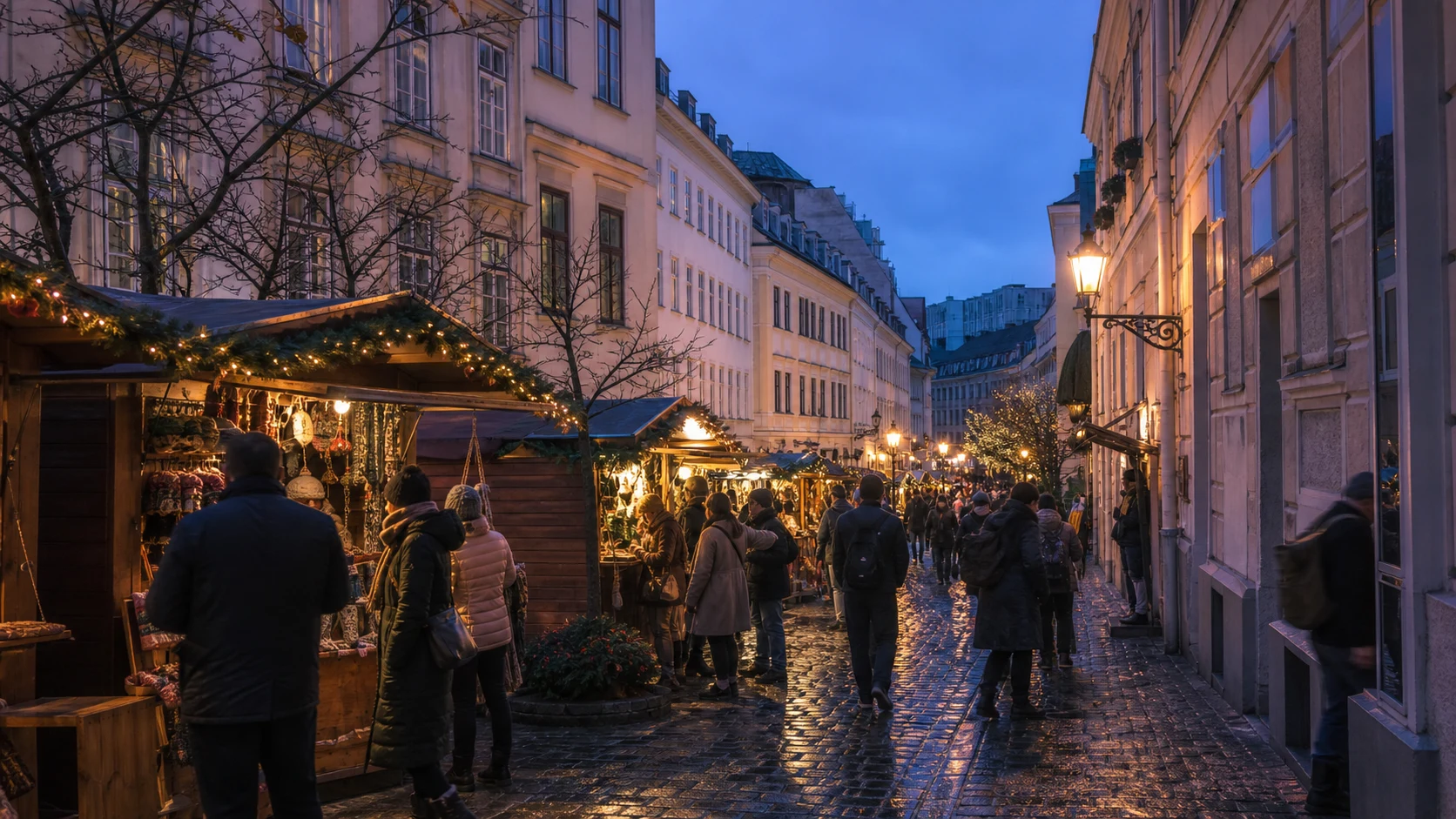
At blue hour in Vienna’s Spittelberg, warm punch steams above a narrow lane while market lights catch on wet cobbles and old Biedermeier facades. That intimate scene is one reason to cross an ocean for Europe’s Christmas markets. The museums, coffeehouses, food, music, and winter streets around it are the reasons to stay. For a first trip in 2026, I recommend four nights in Vienna and three in Salzburg. Nuremberg and Dresden are the stronger pair for traditional crafts; Strasbourg and Nuremberg win for food and distinctive streets. Travel before December 23 for the fullest calendar, keep the trip to one or two bases, and book the central hotels and long-distance rail before optional attractions. This guide gives you the dates that are already official, the route each city earns, and the compromises to accept before paying for anything nonrefundable.
The Dates That Change the Trip
A December 18 arrival and a December 25 arrival are different vacations. Before Christmas Eve, traditional markets are in full motion: stalls open, choirs and ceremonies fill local calendars, and every recommended route below works. After December 23, many German markets close, city hours change, and the trip depends more heavily on museums, restaurants, concerts, and the few markets designed to continue beyond Christmas.
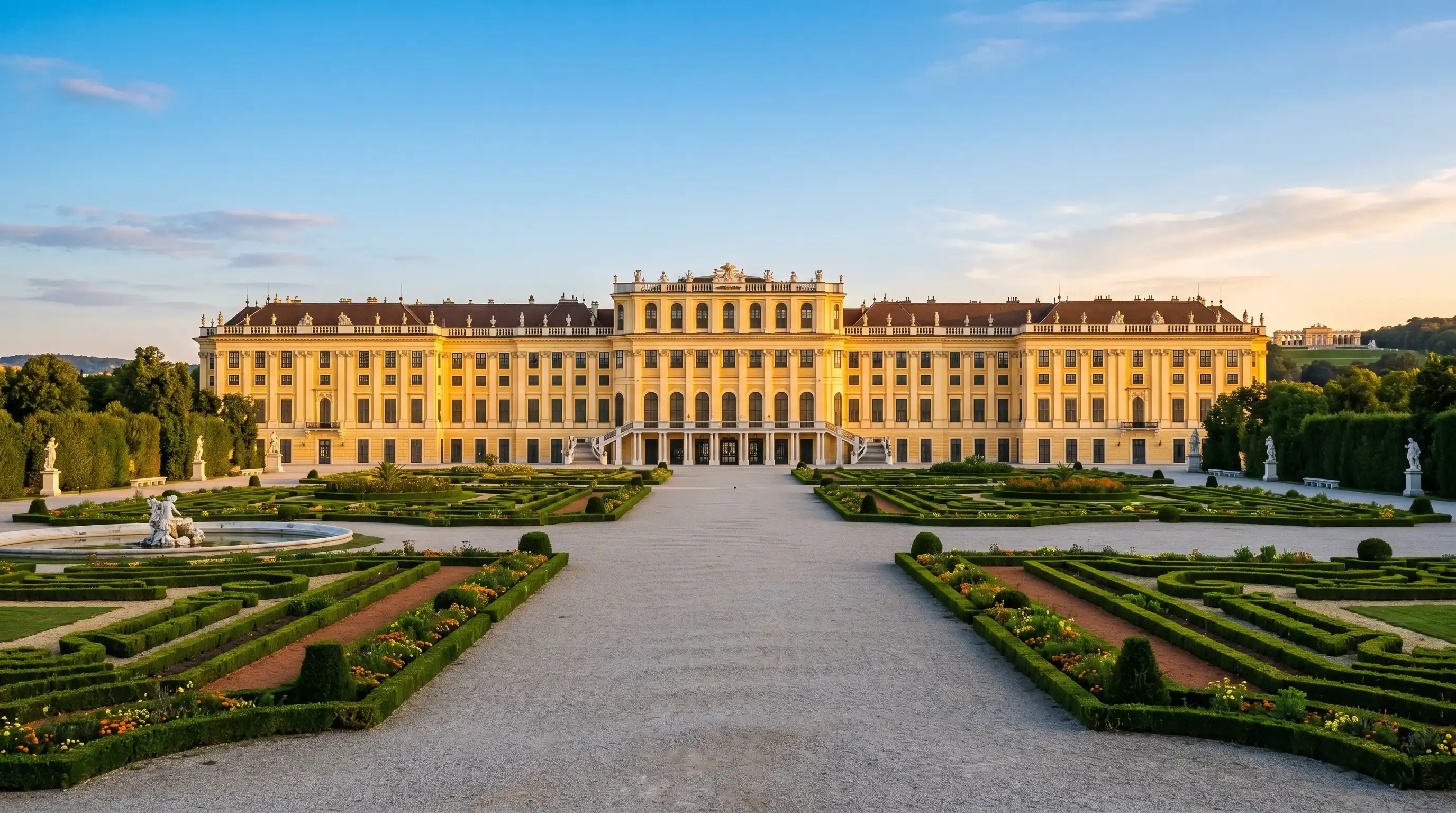
The firmest 2026 dates are already public. Nuremberg’s Christkindlesmarkt runs November 27 through December 24, generally from 10 a.m. to 9 p.m.; its opening ceremony is November 27 at 5:30 p.m. Dresden’s Striezelmarkt runs November 25 through December 24 on the Altmarkt, with more than 200 traders announced by the official organizer. In Vienna, Rathausplatz is listed for November 13 through December 26, while the Schönbrunn market runs November 6 through January 6, 2027. Spittelberg is listed for November 13 through December 23.
Those dates produce a simple recommendation: arrive by December 20 if broad market choice matters, and finish the German portion by December 23. A Christmas-week trip can still be excellent in Vienna, but it should be sold to yourself as Vienna in winter—not as a guaranteed tour of every Advent stall you saw online.
Two date cautions remain. Salzburg’s tourism calendar already contains 2026 Advent events, but the main Domplatz and Residenzplatz market page had not yet rolled from its 2025/26 season when this guide was checked. Strasbourg’s official Christmas page showed a November 26 to December 24 operating window, but its visible copy did not identify the year. Treat both as planning signals, not permission to lock a nonrefundable itinerary. Open the official city pages again before booking.
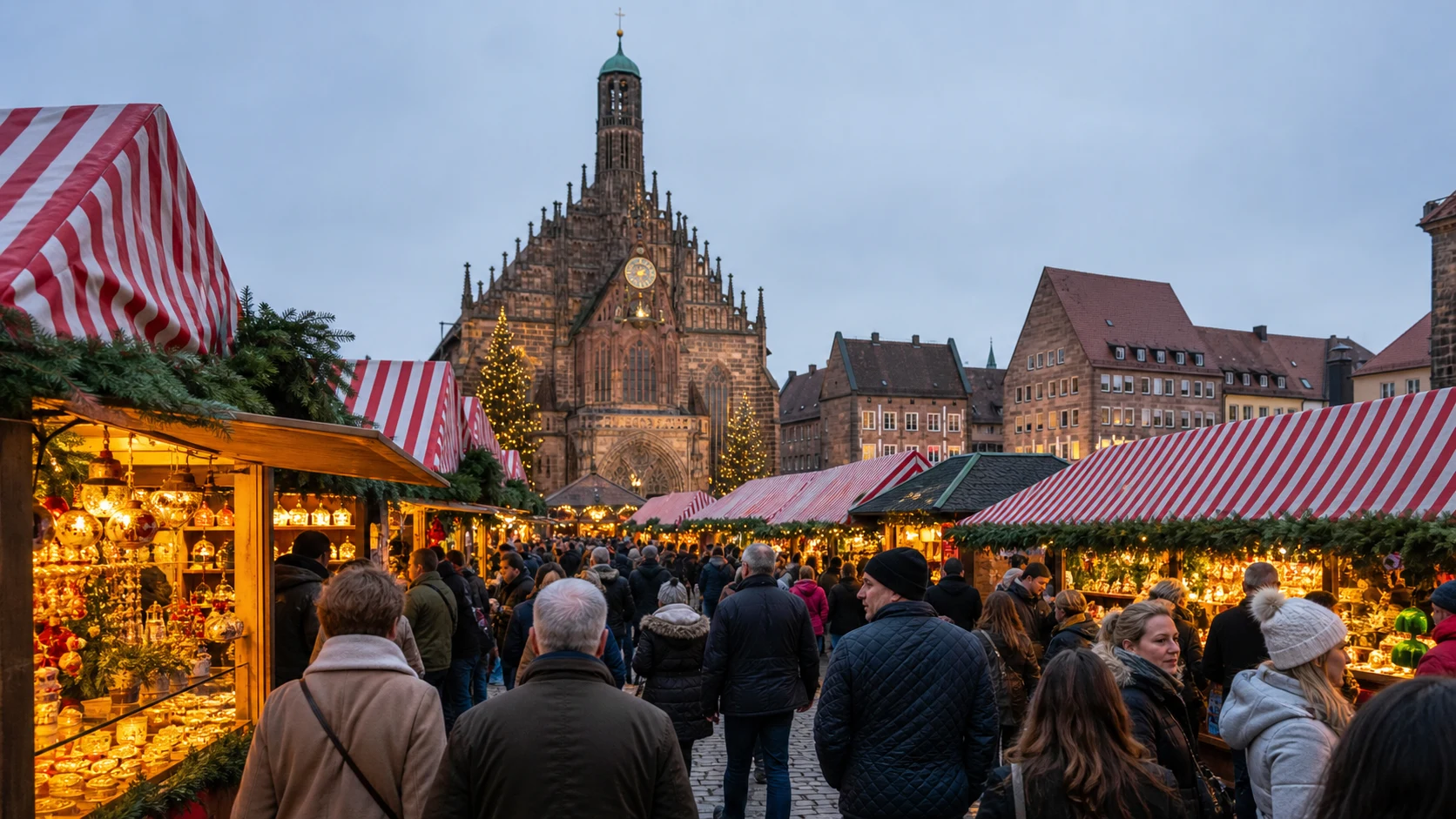
Weekdays matter almost as much as dates. Picture Nuremberg’s Hauptmarkt at Saturday lunchtime: red-and-white roofs disappear beneath a dense crowd, and a five-minute glance at carved ornaments becomes a slow negotiation through winter coats. Sunday night through Thursday gives you more room to look, taste, and return to a favorite square after dark. Weekend ceremonies can be worthwhile, but choose them for the program rather than assuming a busier market is a better one.
Vienna and Salzburg: The Best First Trip
Start with four nights in Vienna and three in Salzburg. The route has a satisfying change of scale: imperial boulevards and major museums first, then Baroque streets, church squares, and dark mountains beyond the Salzburg roofs. It also has insurance against winter weather. If sleet replaces a scenic view, the Kunsthistorisches Museum and a coffeehouse still make a persuasive Vienna day; Salzburg’s churches, fortress, and music keep its old town from becoming a decorative backdrop.
Vienna earns four nights through different neighborhoods, not four laps of one market. Give one evening to Rathausplatz, where scale and spectacle are the point. Use another for the smaller lanes of Spittelberg and the design-minded stalls around Karlsplatz. Pair Schönbrunn’s market with the palace or grounds so the western trip across the city serves more than a cup of punch. Keep the fourth day slower: a major museum, lunch, the 7th district, and a coffeehouse where taking an hour is the activity.
That is also the argument for avoiding a square-facing hotel at any price. A room near a useful U-Bahn line can give you quiet sleep and several markets within an easy ride. A room chosen solely for a view of lights can deliver delivery trucks and closing crews at the hours when you need rest. I would book a cancellable Vienna hotel first, ideally inside the Gürtel or on a direct line into the center, then refine the neighborhood after the market calendars are final.
Salzburg earns three nights with a different rhythm. Use the arrival evening for Domplatz and Residenzplatz, where brass music and Baroque stone create a more compact scene than Vienna’s monumental displays. Give one full day to the fortress, St. Peter’s, Getreidegasse, and a long meal that does not come in a paper tray. The final day can hold an Advent concert or a weather-dependent excursion toward a lake or mountain. If cloud swallows the landscape, keep the day in Salzburg rather than paying to inspect a gray horizon.
The three-night allocation matters. Two nights turns Salzburg into one crowded center day bracketed by arrival and departure. Three lets you see the old town after day-trippers leave and gives winter weather somewhere to go. A third base would fragment the trip: another checkout and station transfer would consume the calm evening that makes Salzburg worth adding. Faster travelers can substitute Nuremberg for Salzburg’s third night, but should not stack it on top of a seven-night plan.
This is my first-timer recommendation because the cities remain valuable when you have had enough stalls. It does require one honest pause: do not finalize Salzburg around assumed dates. Confirm the current Domplatz and Residenzplatz calendar on the official Salzburg Advent page, then book the train and any date-specific concert.
Nuremberg and Dresden: The Craft-Focused Route
Choose three nights in Nuremberg and three in Dresden if the objects, food traditions, and regional histories matter as much as the lights. The scene at Nuremberg’s Hauptmarkt is unmistakable: striped roofs run toward the Gothic Frauenkirche, Lebkuchen scents the aisles, and bratwurst gives you a savory answer to the sugar. The warning is just as specific. At peak weekend hours, the compact square can feel less like browsing and more like a current carrying everyone in the same direction.
Nuremberg earns three nights through contrast. See the main market once in daylight, when you can actually inspect a carved figure or tin ornament, and again after dark. Step beyond it for the partner-city market and a Franconian dinner. Use the full non-market day for the Germanisches Nationalmuseum or the Documentation Center, depending on which history you want to confront. Those choices keep the city from becoming a stage set for gingerbread.
Dresden earns its three nights on the same principle. The Striezelmarkt’s stepped wooden pyramid, Stollen, and Erzgebirge craft traditions provide the Advent center. Then the reconstructed Frauenkirche, the Zwinger, the Old Masters Picture Gallery, and the Elbe give the daytime weight. Look for work with a regional identity—wooden figures, arches, pyramids—rather than treating every stall as proof of authenticity. “Handmade-looking” and locally made are not synonyms; ask where an object comes from before carrying it home.
The official 2026 dates make this the easiest route to secure. Nuremberg opens November 27 and Dresden November 25; both close December 24. I would choose a Monday-through-Thursday core, stay central enough to walk home, and avoid paying extra to sleep directly above a main square. Reserve the hotels first. Museum tickets are usually more flexible than scarce well-located rooms, and neither city improves when you must commute past the old town to reach it.
Three nights in each city fill naturally: arrival and first market circuit, a museum-and-old-town day, and a slower city day with a second evening. Leipzig can improve a ten-day trip, especially for a traveler interested in music, but adding it inside six nights mostly creates luggage movement. The better action is to keep two bases and let Dresden’s wider Advent landscape provide the variation.
Strasbourg and Nuremberg: The Food-and-Streets Route
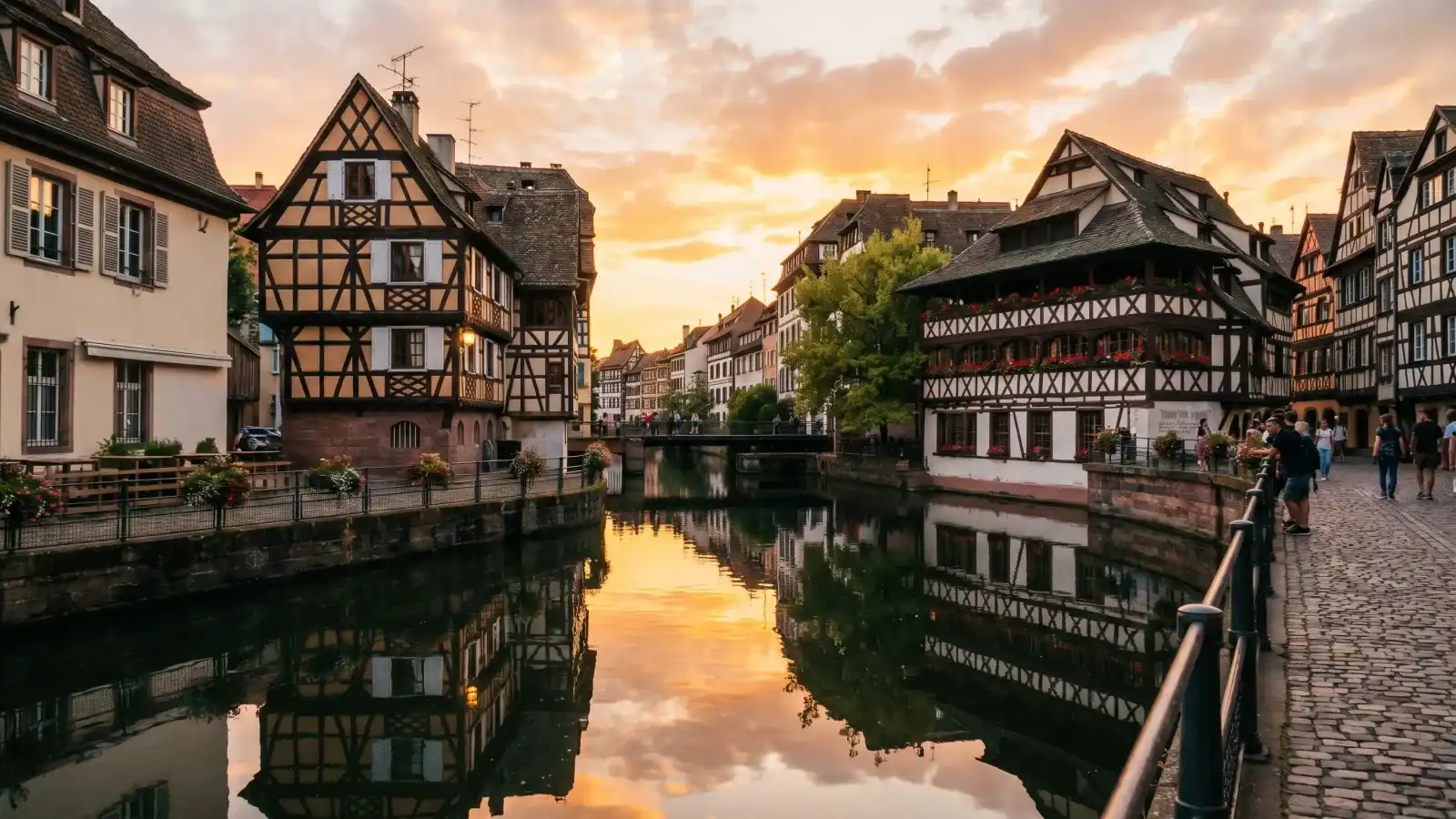
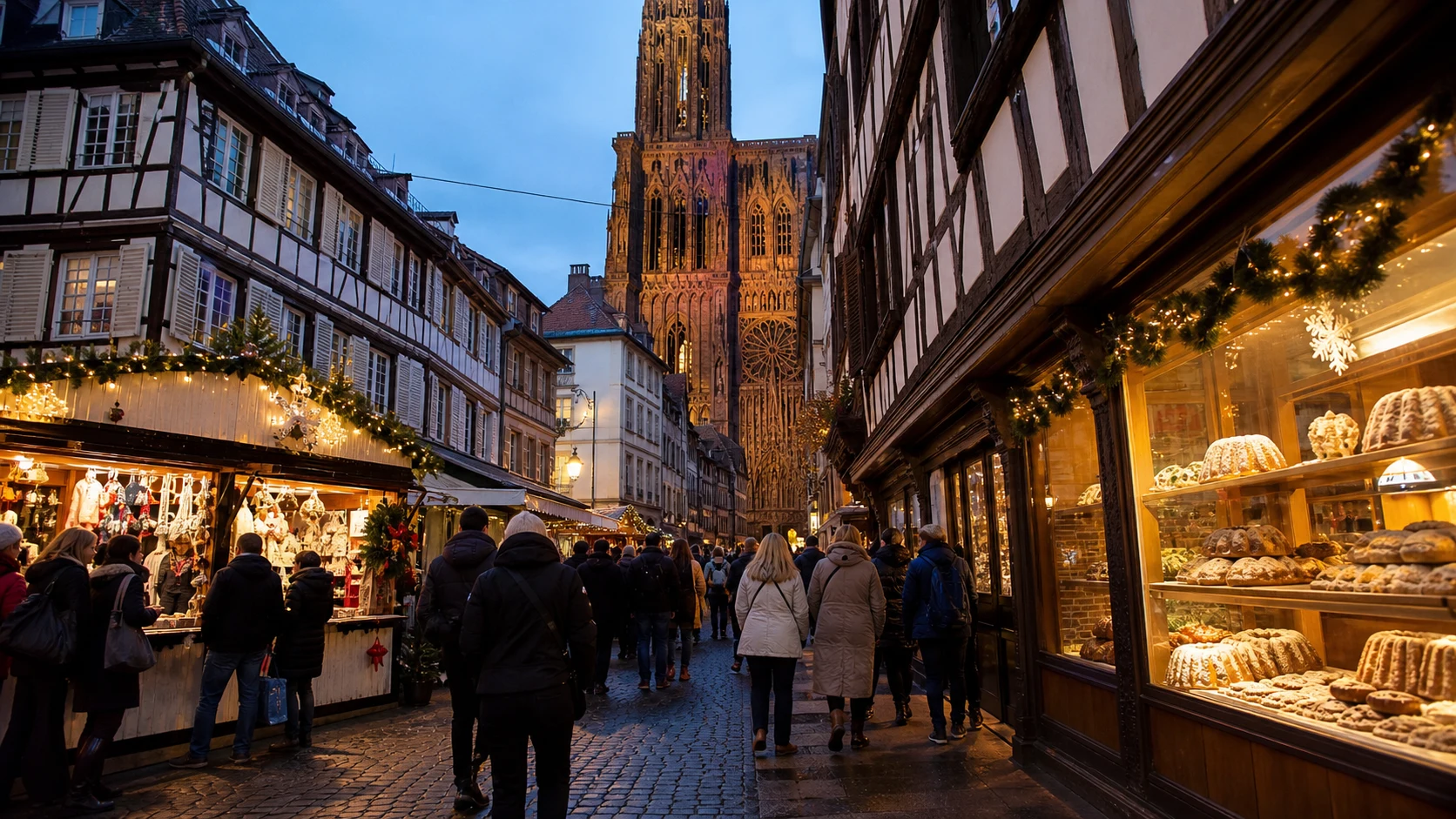
Strasbourg makes its case before you reach a stall. Half-timbered facades lean over narrow lanes, the cathedral’s sandstone mass appears between roofs, and bakery windows fill with bredele and kougelhopf. Around Place Kléber and Place de la Cathédrale, the city itself carries the decoration. Pair four nights there with three in Nuremberg, and the transition from Alsatian baking and French-German streets to Franconian sausage, gingerbread, and striped-roof tradition feels like a journey rather than a duplicate market in a new square.
Strasbourg earns four nights with two distinct evening circuits, not one heroic march across every market location. Use the first for the cathedral quarter and Place Kléber. Return on another evening through Petite France and the smaller surrounding streets, stopping for food rather than building dinner from five sweet samples. In daylight, give the cathedral and old town the attention they would deserve in any season. A long Alsatian lunch is not dead time; it is part of the reason to choose this route.
The fourth night creates room for Colmar without creating another hotel move. Go as an excursion if current trains and market controls make the day sensible, then return to the Strasbourg room you already know. Sleeping in Colmar can be appealing on a longer Alsace trip, but in seven nights it adds a checkout without adding a new region. If moving luggage is the price of seeing the town after day-trippers leave, make that trade deliberately rather than treating it as free variety.
Nuremberg then earns the same three nights described above: Hauptmarkt, a museum or historic site, and one unhurried Franconian day. What improves the trip is the cultural contrast. Strasbourg gives you timber, cathedral streets, wine-country food, and French civic life; Nuremberg gives you a compact German market tradition and direct 2026 certainty.
The uncertainty sits in Strasbourg. Its official visitor page currently displays a November 26 to December 24 window and daily hours, but the visible text did not state that those dates belong to 2026 when checked on August 18. I would favor weekday dates and hold a refundable room, then revisit the official Strasbourg Christmas site before buying inflexible transport. A beautiful planning assumption is still an assumption.
Vienna as a Six-Night, One-Base Trip
There is no prize for changing hotels. Six nights in Vienna is the strongest answer for a traveler who dislikes luggage days, wants substantial indoor culture, or cannot arrive until Christmas week. The city has several markets with different settings, and the official 2026 calendar gives it later-running options: Rathausplatz continues through December 26 and Schönbrunn through January 6, 2027.
Vienna earns all six nights. One day can pair the Kunsthistorisches Museum with the center; another can combine Schönbrunn and its market. Walk the 7th district and Spittelberg, spend an evening around Karlsplatz, and leave time for the Belvedere, the Prater, or a concert you chose for the program rather than the word “Vienna.” A slow coffeehouse morning also belongs in the allocation. It keeps the week from becoming six consecutive nights of hot drinks and crowded stalls.
A Bratislava day can add contrast if current trains and holiday hours cooperate. The Wachau is another possibility when weather and seasonal schedules make sense. Neither is required. The single-base plan works precisely because Vienna has enough neighborhoods, collections, food, and music to absorb winter without turning every open hour into an excursion.
Choose this plan if the thought of another station feels heavier than the promise of another market. Add Salzburg only when smaller scale and an Alpine edge are central to the trip; add Nuremberg only when its German tradition is important enough to surrender a Vienna day and accept another transfer. Otherwise, unpack once and let the city change around you.
What to Book First
Book the piece that controls the shape of the trip, then stop. For most travelers, that means a refundable central hotel in each base. Advent weekends compress room choice quickly, and saving money far outside the center can remove the spontaneous evening return that makes these markets pleasurable. Check noise as well as distance: a street behind a main square can be more useful than a room directly over it.
Next, reserve the long-distance journey that connects the bases once both city calendars are confirmed. Choose a departure that protects a morning or evening instead of automatically selecting the cheapest train at an awkward hour. The Europe train guide explains the operator logic; the actual railway should supply the current timetable and fare conditions.
Only then should you buy date-specific programs. Nuremberg’s November 27 opening ceremony is a real reason to accept opening-weekend crowds. A Vienna concert may be worth structuring an evening around when you care about the performers and venue. Generic “Christmas concert” inventory is not automatically scarce or special because a reseller adds gold lettering.
Leave ordinary museums and attractions flexible unless a timed entry is genuinely important. Winter weather may make a palace day more attractive than the neighborhood walk you planned, or clear skies may ask you to stay outside. One anchor per day is enough. The reader action is simple: secure rooms, confirm official dates, connect the bases, and allow the city to decide the rest.
Choose the Cities You Want After the Stalls Close
The right route becomes obvious when you imagine 2 p.m., before the lights take over. If you want paintings, coffeehouses, music, and a compact Baroque finale, choose Vienna and Salzburg. If you want to compare gingerbread, Stollen, woodcraft, and two German cities with firm calendars, choose Nuremberg and Dresden. If cathedral streets, Alsatian baking, and a food-centered contrast matter most, choose Strasbourg and Nuremberg—after the Strasbourg dates receive their year-specific confirmation.
Then resist the extra pin on the map. Christmas markets become memorable through differences in streets, food, scale, and the city day around them. Two bases give those differences time to appear. Five bases give you a very festive collection of station boards.
Open the two official city calendars for the route you prefer and place their confirmed dates side by side. If both work, reserve cancellable rooms before adding an excursion or ticket. If one calendar is still provisional, keep the room flexible and set a reminder to check again; do not let a plausible date harden into an expensive assumption.